Description
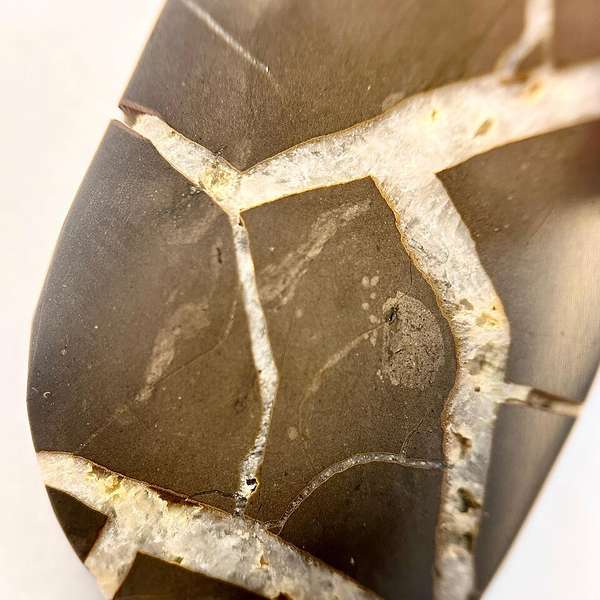
The rarest things on Earth were formed by the most ordinary processes, repeated for eons. Septarian nodules form in marine muds: organic-rich sediment hardens into an oval nodule, then shrinks as it dries, cracking into a cage-like pattern (‘septa’) that fills with calcite, aragonite, or barite crystals. Polished in half, the resulting pattern looks like stained glass in earth tones — a natural mosaic that took millions of years to complete.
This specimen originates from Bingham, Utah, USA, one of the world’s most significant localities for this type of material. Collectors and scientists have drawn from this region for generations, and for good reason: the combination of geological conditions here produces specimens of exceptional quality and clarity.
Every specimen is unique. Photographs approximate the visual experience, but the real thing — its weight, its luster under a raking light, the way it catches the corner of your eye — can only be experienced directly.